
Part V · Historical Male Survivors Series · 1990–1999
The Call Sheldon Kennedy Finally Made
Kennedy had already reached the NHL when he saw his former junior coach around younger players in Calgary, forcing him to decide whether his own history could remain private.
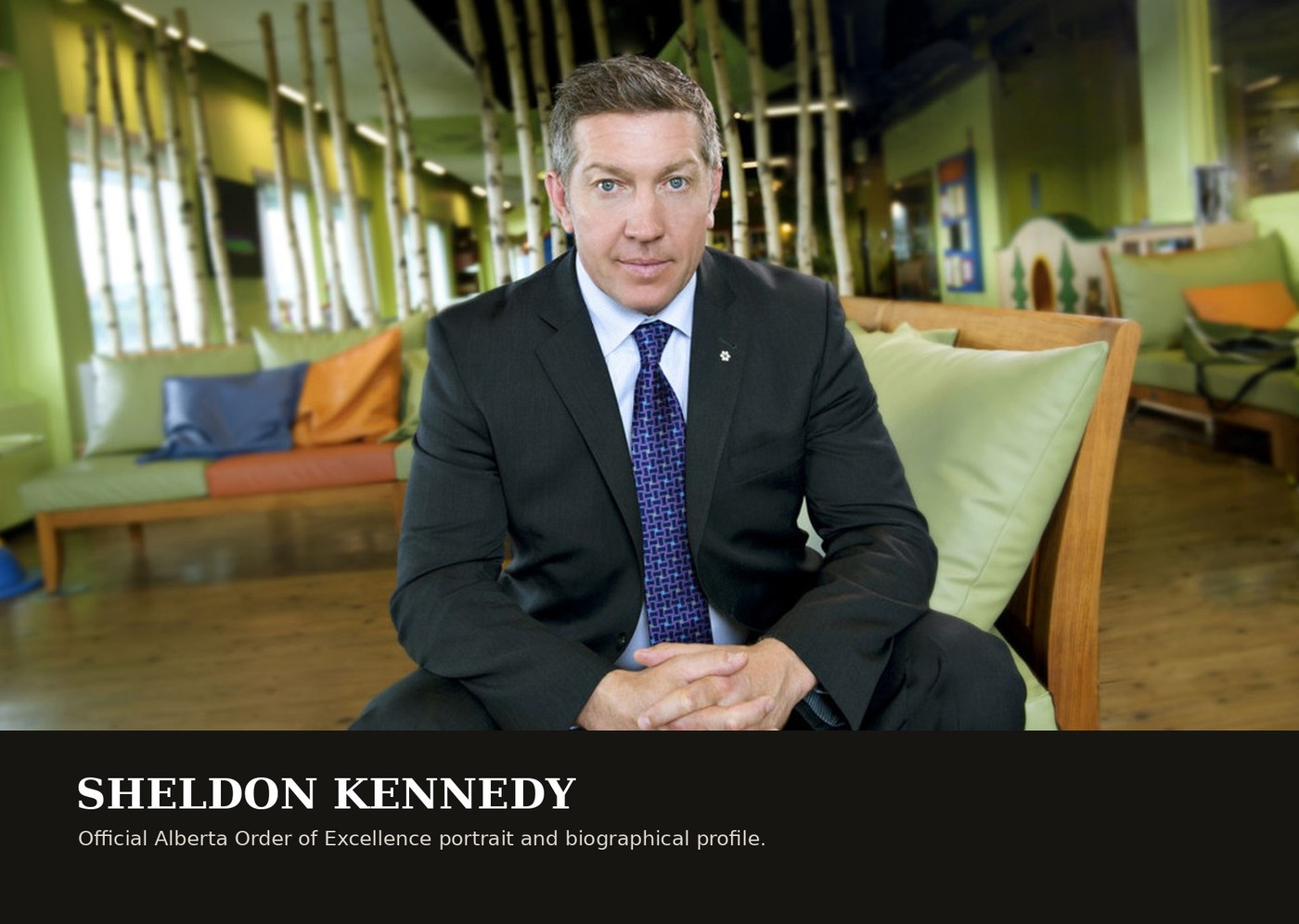
Sheldon Kennedy had already reached the National Hockey League when the past appeared outside a locker room in Calgary. During 1995, after Kennedy joined the Calgary Flames, he saw his former junior coach Graham James around younger players from the Calgary Hitmen, who shared the Saddledome with the professional team. Kennedy’s wife was pregnant, and the sight of James with boys approaching the same hockey system pushed an old private fear into his life as an expectant father. The question he carried was no longer limited to whether anyone would believe what had happened years earlier, because he had begun wondering whether another child might be living through it.
Kennedy had first met James while growing up in Manitoba, where hockey offered a route from a dairy farm toward the life he had imagined during Saturday broadcasts. James earned the trust of the Kennedy family and first sexually assaulted him when Kennedy was fourteen, according to the account preserved by the Alberta Order of Excellence. Kennedy later estimated that James assaulted him approximately 350 times while also controlling a path through junior hockey that could lead toward the NHL. The abuse remained hidden as Kennedy won a Memorial Cup, played internationally for Canada, and began his professional career with Detroit in 1990, which meant that public achievement developed beside injuries that spectators could neither recognize nor explain.
In 1996, Kennedy held a newspaper carrying another account of his troubled behavior and telephoned a Calgary police detective. He feared that a player known publicly as a troublemaker would be measured against a coach known publicly as a winner, although the detective listened and believed him. Another former player also came forward, and Calgary police charged James on November 22 with two counts of sexual assault involving hundreds of encounters over approximately ten years. James pleaded guilty on January 2, 1997, received a sentence of three and one-half years, and was banned for life from coaching by the Canadian Hockey Association.
Kennedy then identified himself publicly during January 1997, placing his own name inside a prosecution that could otherwise have remained attached only to James. The disclosure arrived after years of news coverage about Kennedy’s arrests, substance use, and erratic behavior, so people who had watched consequences unfold could finally learn part of the history beneath them. He received approximately 200,000 letters of support and became the Canadian Press Newsmaker of the Year, yet those numbers do not erase the risk he calculated before making the call. They show how many people answered after one man concluded that younger players might remain exposed if he stayed silent.
The investigation that had been stopped
The decade had opened with another Canadian record showing what could happen when boys spoke and authorities controlled the file. Newfoundland’s Royal Commission of Inquiry into the Response of the Newfoundland Criminal Justice System to Complaints examined allegations from Mount Cashel, a boys’ home operated by the Christian Brothers in the provincial capital. Former resident Shane Earle had returned the old investigation to public attention in 1989, after the allegations he and other boys made during the 1970s had failed to produce public prosecutions. Justice Samuel Hughes completed a two-volume report after reviewing the police investigation, the justice department, social services, and the institutional practices surrounding the boys.
The report’s findings went beyond a vague description of missed warnings because Hughes reconstructed how the 1975 investigation had been interrupted. Detective Robert Hillier was directed to alter reports and remove allegations of sexual abuse, while orders from senior police officials caused him to stop before finishing his work. Hughes found that this conduct departed from accepted police policy and that the directions impeded officers investigating the boys’ statements. The altered reports still contained abundant allegations in attached materials, which made the failure to proceed harder to attribute to a simple lack of information.
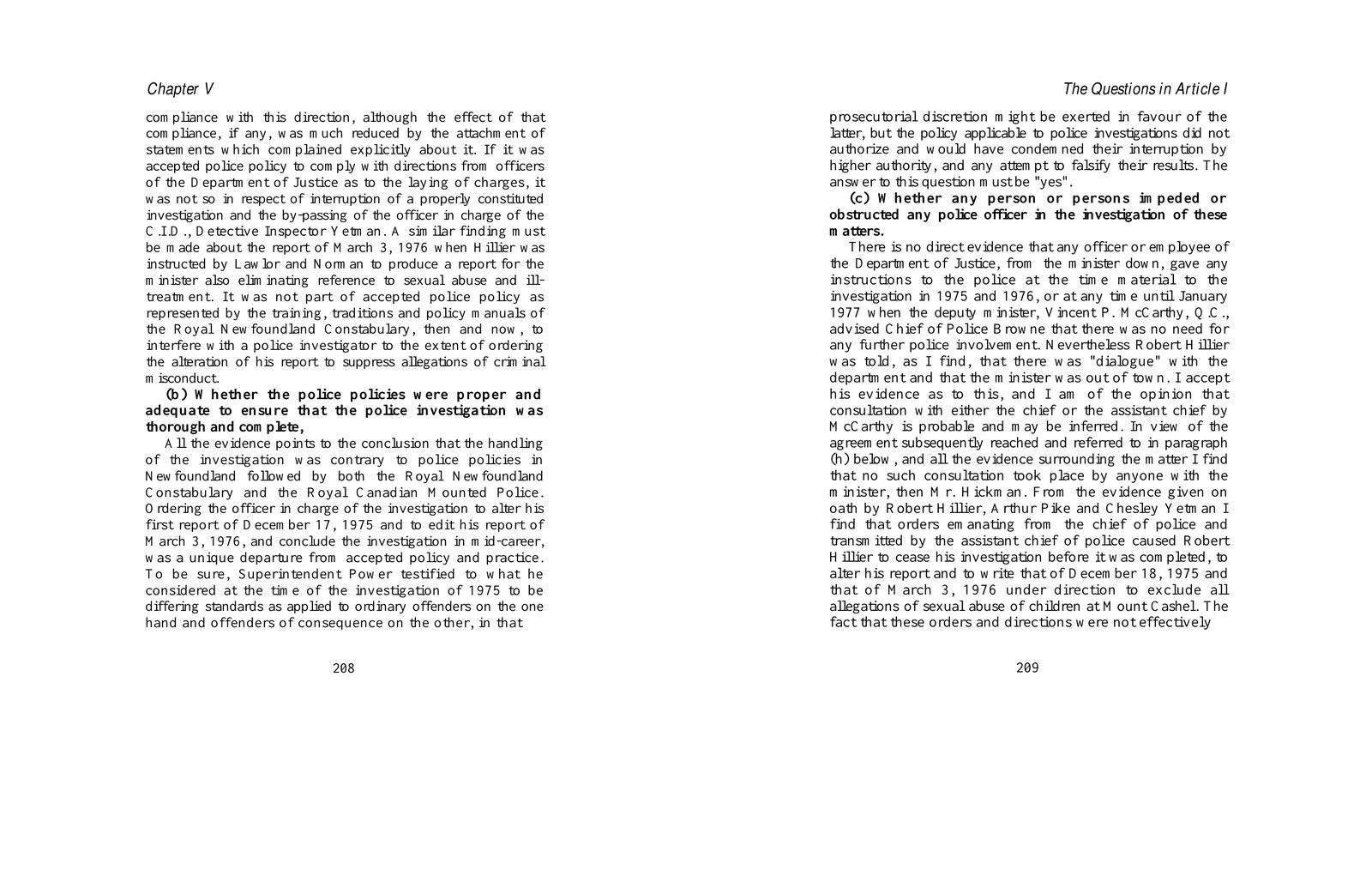
Mount Cashel mattered during the 1990s because the inquiry placed administrative choices into a public record while former residents were still pursuing criminal cases, civil claims, and treatment. The report could describe suppression, delayed justice, and the obligations of police and child-welfare agencies, although publication could not return the years lost after the boys first spoke. A compensation agreement reached later in the decade followed litigation involving former residents, government, and the Christian Brothers, while many survivors continued living with injuries that no settlement could standardize. The case demonstrated that institutional recognition often began after survivors forced authorities to reopen what their own systems had closed.
When the law finally named male rape
British law entered the decade with a distinction that many survivors already understood as unreal. A man could describe forced anal intercourse, yet the legal offense of rape remained defined around a female victim, while forced and consensual sexual acts between men could be processed through other language. The Criminal Justice and Public Order Act 1994 changed that position in England and Wales by replacing the old provision with a section titled “Rape of woman or man.” The enacted text stated that a man committed rape when he had vaginal or anal intercourse with a person who did not consent and he knew about that absence of consent or was reckless toward it.
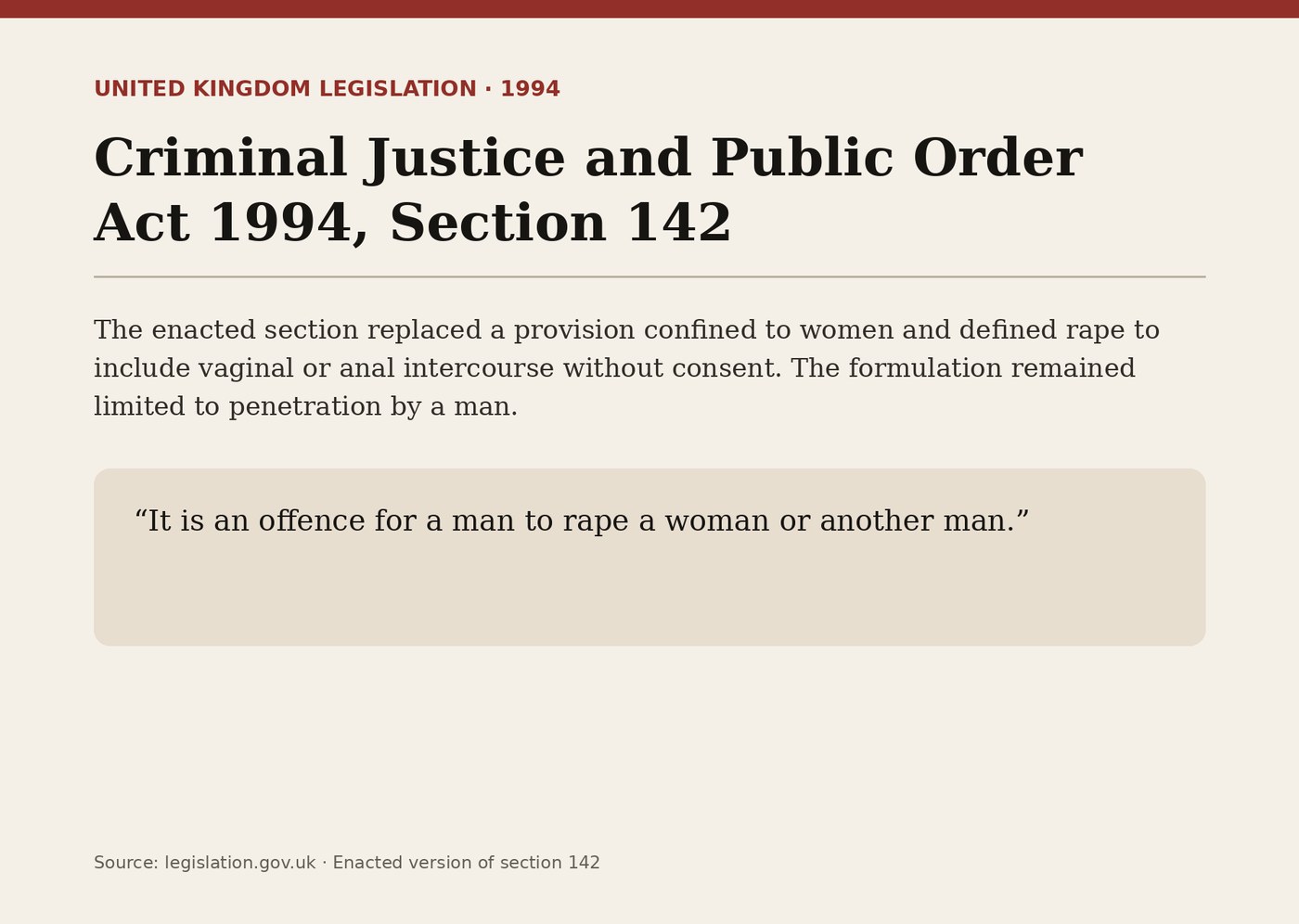
The change gave male survivors a legal word that separated an assault from consensual sex, although the new section still defined rape through penile penetration by a man. It therefore recognized men as possible victims while leaving other forced sexual acts under separate offenses, and legal recognition did not determine how police, courts, families, or services would respond to a report. SurvivorsUK and other advocates had already spent years receiving calls from men whose experiences exceeded the language and resources available to them. The statute placed male rape inside criminal law during 1994, while the practical work of making that recognition usable remained spread across small services and uneven institutions.
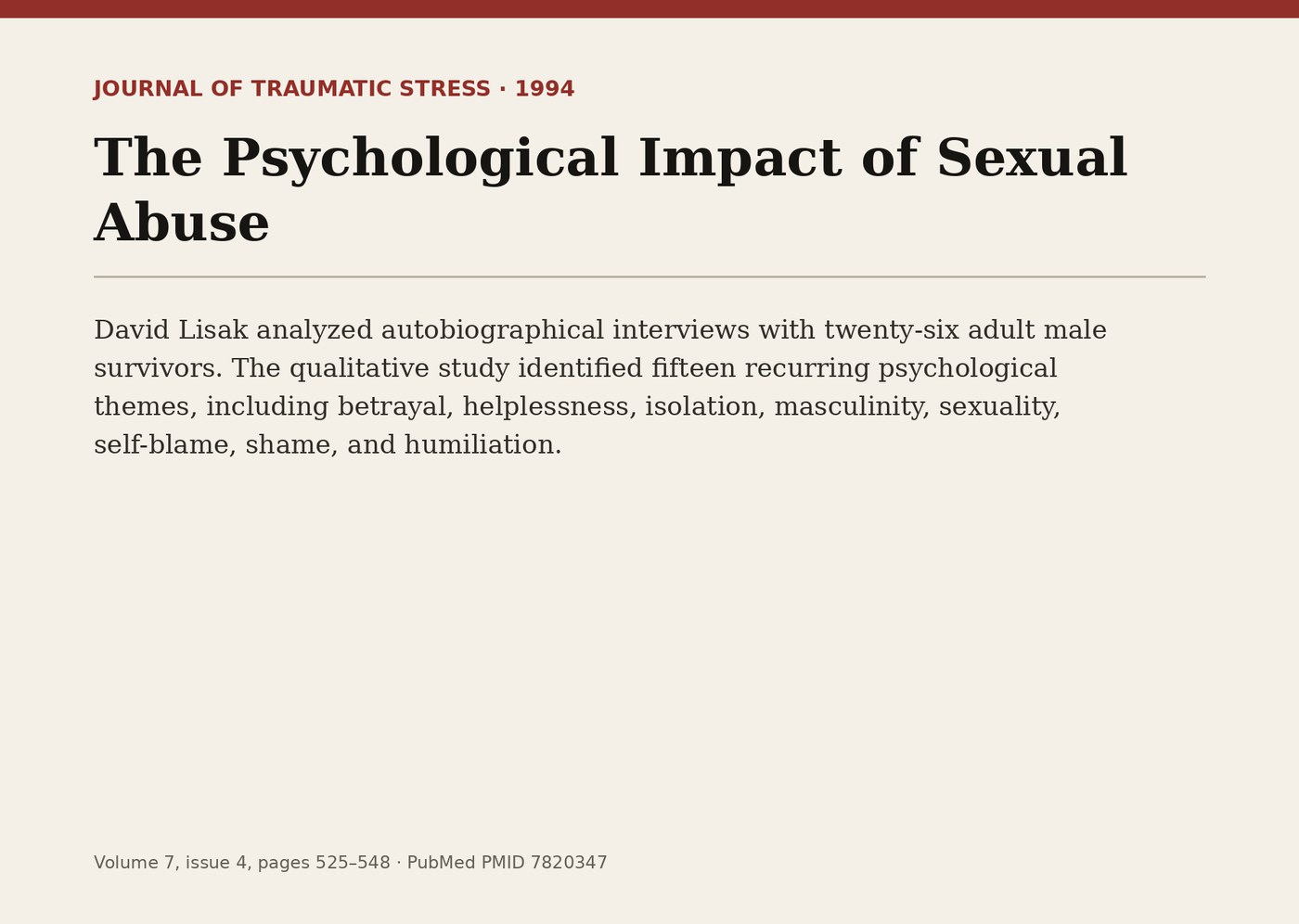
Clinical research was also recording what happened when men tried to understand experiences that had rarely been discussed around them. Psychologist David Lisak published a 1994 analysis of autobiographical interviews with twenty-six adult men who had survived childhood sexual abuse. The interviews produced recurring themes involving anger, betrayal, fear, helplessness, isolation, masculinity, sexuality, self-blame, guilt, shame, and humiliation. Because the study used a small qualitative sample, it could not estimate how often those effects occurred among survivors generally, although it showed how closely private distress could remain tied to the beliefs men had learned about strength, control, and sexual identity.
The National Organization on Male Sexual Victimization grew from the same period of emerging professional and survivor contact. Participants at conferences beginning in 1988 continued building a network, and a core group decided during November 1994 to create a nonprofit organization devoted to male survivors. The organization incorporated in Minnesota during November 1995 and later adopted the name MaleSurvivor, while its early work included conferences, professional exchange, survivor participation, and a website. Its formation did not create a national treatment system, although it gave men and practitioners a place to find one another without treating male victimization as an unusual exception requiring explanation before help.
RAINN also began operating the National Sexual Assault Hotline during 1994 by connecting callers with local sexual-assault service providers across the United States. The network served survivors regardless of gender, yet local capacity and experience still varied considerably, especially for men seeking counselors who understood male disclosure without redirecting it toward assumptions about sexuality or strength. A national telephone number could shorten the search for an available program, although it could not guarantee that every community had appropriate long-term care. The decade was producing recognizable entry points for survivors while leaving much of the sustained work dependent on geography, money, and the knowledge of individual providers.
The years after his name became public
Kennedy’s public disclosure moved through a culture that could celebrate his courage while still asking why he had waited. His own account supplied the answer through the power James held over hockey, the fear that people would believe a successful coach over a troubled player, and the absence of education that might have helped a fourteen-year-old recognize grooming and tell someone safely. The years between the first assault and the police call contained professional hockey, marriage, addiction, arrests, and repeated efforts to live around an experience that had never become safely discussable. Public attention arrived only after Kennedy and another complainant provided the evidence that allowed police to act.
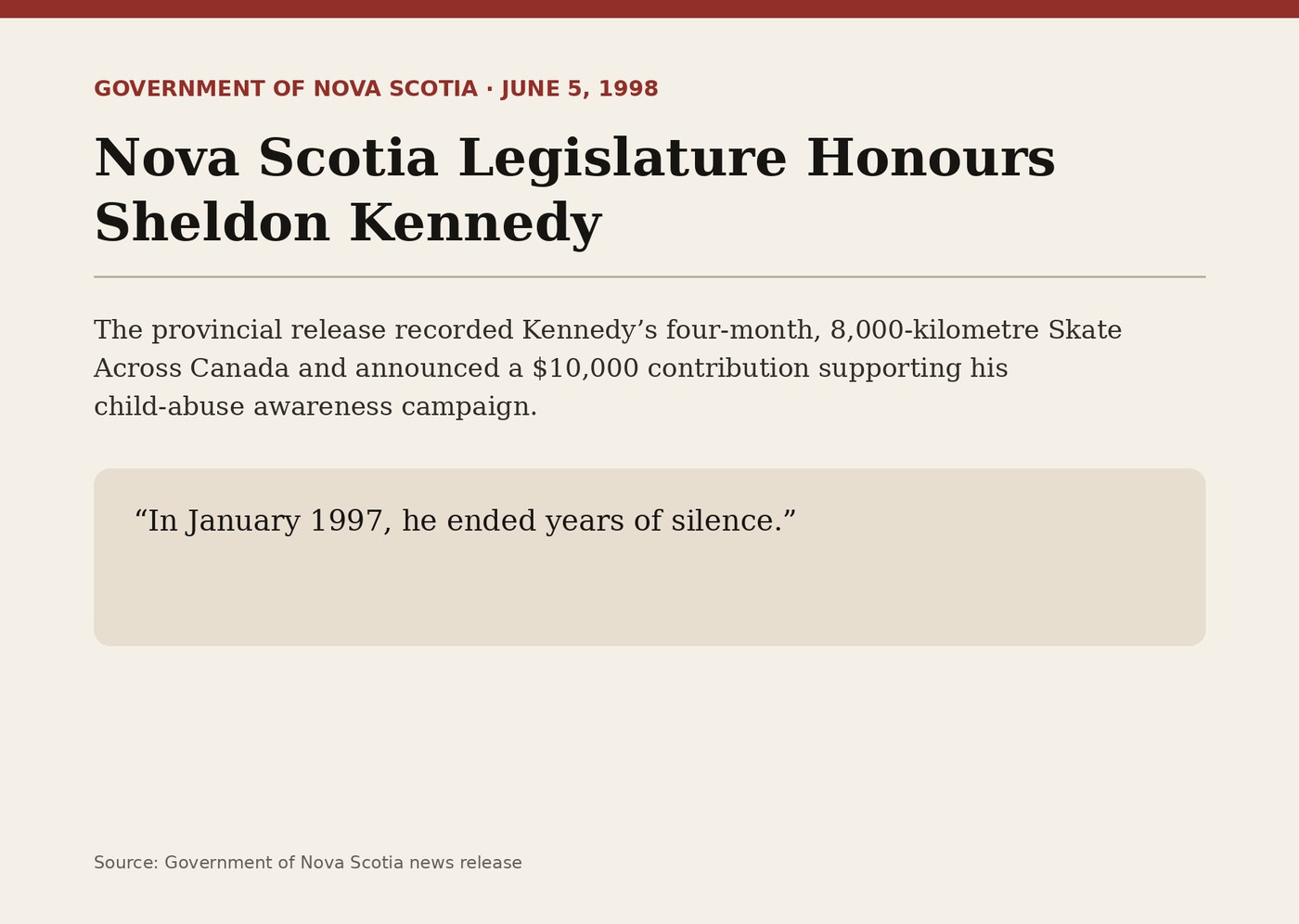
In 1998, Kennedy began a four-month inline-skating journey across Canada that covered approximately 8,000 kilometres and raised awareness and money for abuse prevention. The Nova Scotia government marked his arrival by contributing $10,000, and its contemporary release recorded that he had ended years of silence during January 1997. Kennedy later described hearing as many as twenty-five accounts of abuse in a single day while traveling, which turned the route into a moving reception point for disclosures from people who approached him. The skate raised approximately $1.2 million for the Canadian Red Cross and revealed the distance between public claims that these cases were exceptional and the volume of private histories waiting beside the road.
Those encounters also complicate any version of Kennedy’s story that ends when the courtroom closes. Speaking publicly did not separate him from trauma, addiction, or the work required to remain alive and connected after years of concealment. It did allow other survivors to recognize someone whose athletic career had not protected him and whose public problems had not disqualified his account. By the time a television film based on his life appeared in 1999, Kennedy had become widely associated with survivor advocacy, even though the public version of his history could never contain what disclosure demanded from him privately.
Counted inside a survey that centered women
The National Institute of Justice and the Centers for Disease Control and Prevention published findings from the National Violence Against Women Survey during 1998. Its title reflected the project’s primary focus, while the survey itself included telephone interviews with 8,000 women and 8,000 men so researchers could compare experiences of rape, physical assault, and stalking. The report stated that three percent of surveyed men, approximately one in thirty-three, reported a completed or attempted rape at some point during childhood or adulthood. Applied to the adult male population used by the study, that estimate represented approximately 2.78 million men.
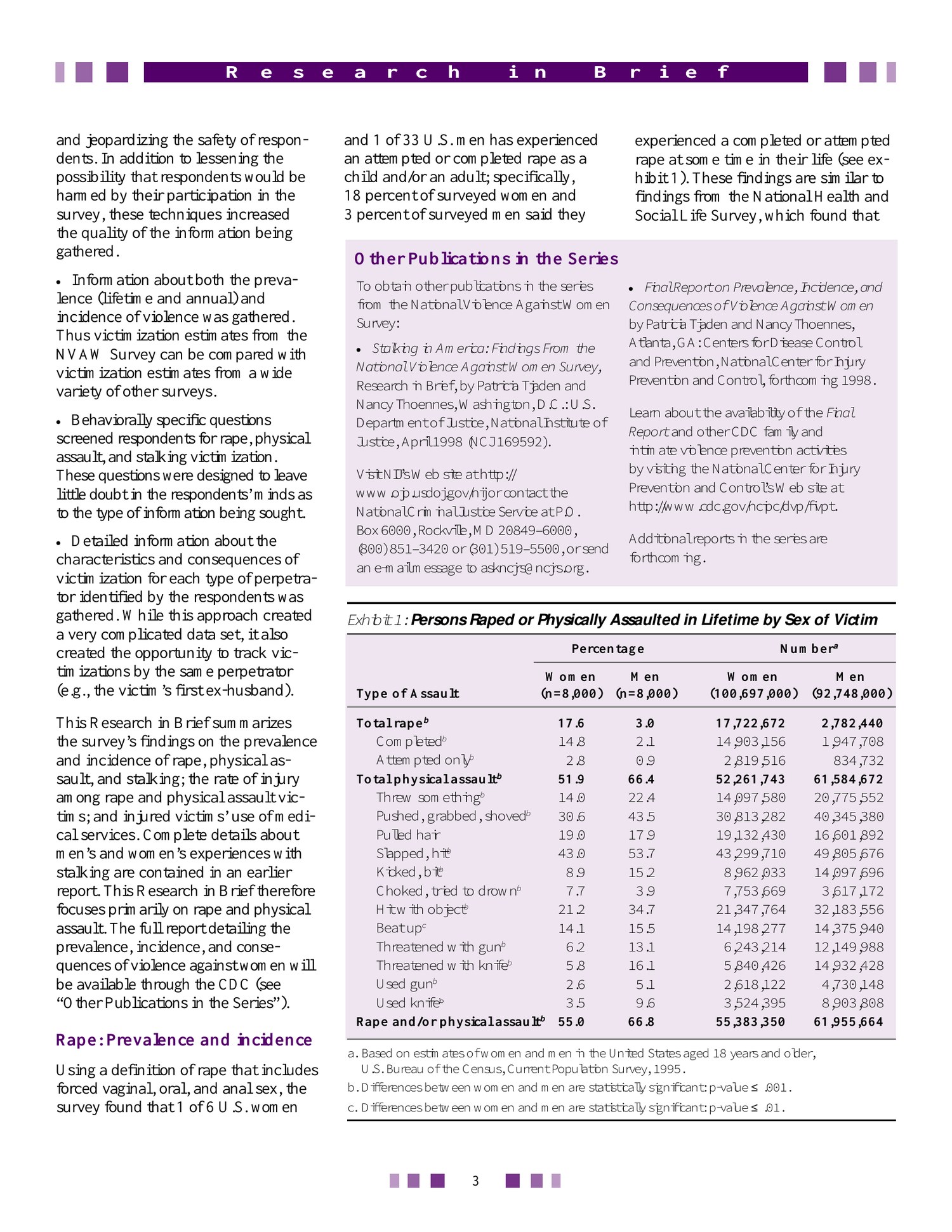
The same report estimated that approximately 92,700 adult men experienced completed or attempted rape during the preceding twelve months. Telephone surveys depend on respondents recognizing behavior, deciding to disclose it, and remaining reachable through the sampling method, while the report’s definition also excluded some forms of forced sexual contact. Those limits mean the numbers should be read as survey estimates rather than a complete census of male victimization. Even with those qualifications, a federal publication whose framing centered violence against women had generated national male estimates too large to reconcile with the old assumption that male rape barely occurred.
The decade therefore closed with male survivors present in law, research, advocacy organizations, national survey tables, and public testimony from a professional athlete. Their presence had not produced consistent treatment, reliable institutional accountability, or a culture in which disclosure carried little risk. Mount Cashel showed authorities altering a record after boys spoke, while Kennedy’s case showed an adult survivor carrying the consequences until concern for younger players moved him toward police. The difference between those histories depended heavily on whether the person receiving a report allowed the investigation to continue.
Kennedy made his call while holding a newspaper that contained one public version of his life. After the detective listened, the events hidden beneath that version entered a police file, a courtroom, and eventually a national conversation traveling beside him across Canada. People approached along the skate route with accounts they had carried quietly, sometimes offering as many as twenty-five in one day. Their stories accumulated beyond any single prosecution, showing how much of the decade’s apparent discovery had already been lived in private.
Sources used in this article
- Alberta Order of Excellence, “Sheldon Kennedy,” biographical profile.
- Government of Nova Scotia, “Nova Scotia Legislature Honours Sheldon Kennedy,” June 5, 1998.
- The Canadian Press, chronology of Graham James’s legal history, republished by CityNews.
- S. H. S. Hughes, Royal Commission of Inquiry into the Response of the Newfoundland Criminal Justice System to Complaints, volumes 1 and 2, 1991.
- Newfoundland and Labrador Heritage, “Mount Cashel Orphanage Abuse Scandal Timeline.”
- Criminal Justice and Public Order Act 1994, section 142, enacted version.
- David Lisak, “The Psychological Impact of Sexual Abuse: Content Analysis of Interviews with Male Survivors,” Journal of Traumatic Stress 7, no. 4 (1994), 525–548.
- MaleSurvivor, “History of the Nonprofit Organization for Male Sexual Abuse.”
- RAINN, organizational history and National Sexual Assault Hotline materials.
- Patricia Tjaden and Nancy Thoennes, Prevalence, Incidence, and Consequences of Violence Against Women: Findings From the National Violence Against Women Survey, National Institute of Justice and Centers for Disease Control and Prevention, 1998.
The article separates Kennedy’s 1996 police report from his January 1997 public disclosure, treats small qualitative studies within their limits, and presents federal survey figures as estimates rather than a complete count.